


New Guide Helps Universities Track Progress on the Sustainable Development Goals
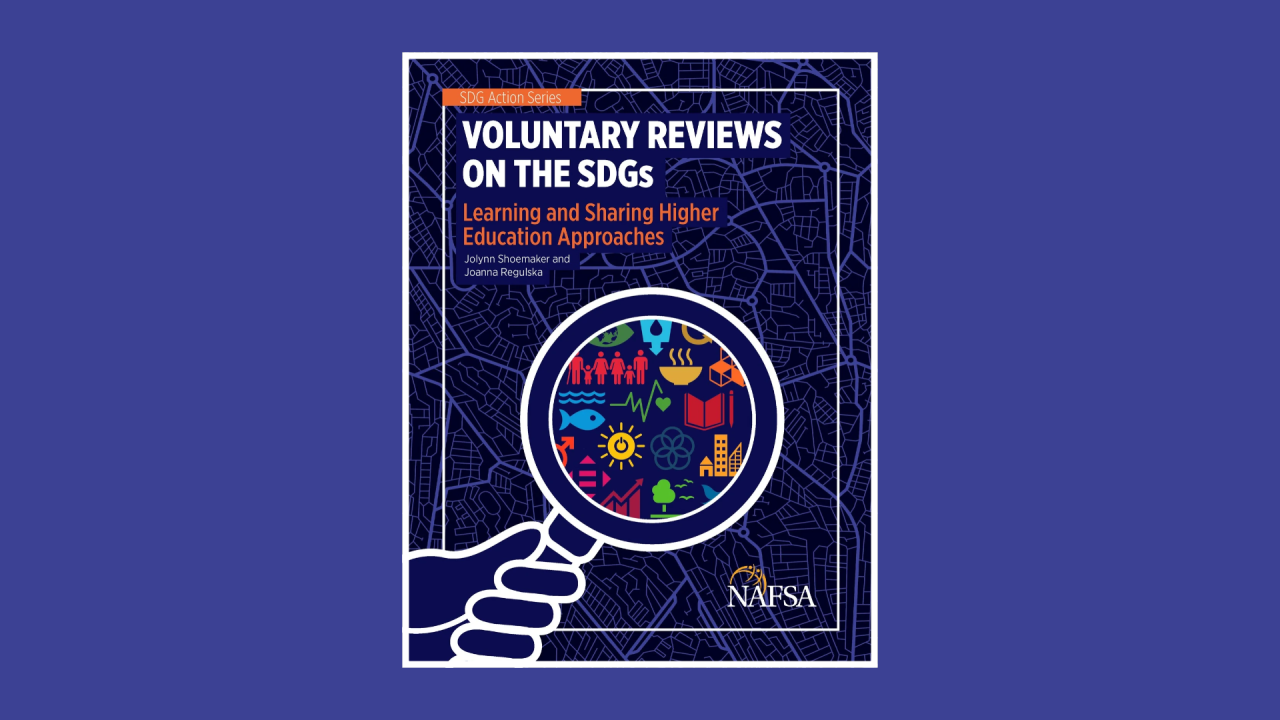
A new guide by Jolynn Shoemaker, interim executive director of Academic Programs and Partnerships in UC Davis Global Affairs, and Joanna Regulska, who recently retired as UC Davis vice provost and dean of Global Affairs, shows how universities can document their contributions to the United Nations Sustainable Development Goals (SDGs) and use their findings to guide future work. Voluntary Reviews on the SDGs: Learning and Sharing Higher Education Approaches is the second guide in NAFSA’s SDG Action Series.
Using examples from around the world, the guide explains how universities can conduct their own reviews and contribute to reviews led by local and national governments. It includes a step-by-step checklist for planning a review and shows how the findings can help institutions strengthen partnerships. Each institution can choose an approach that fits its priorities and start with work already underway in teaching, research, operations or community engagement.
The authors drew on lessons from the City of Sacramento’s 2024 Voluntary Local Review, a joint project between the city and UC Davis. The review maps Sacramento’s 2040 General Plan and Climate Action & Adaptation Plan to the 17 SDGs. The Bay Awards will feature the project in its repository of the 100 best projects from the 2027 edition. UC Davis also completed its own Voluntary University Review in 2021, documenting the university’s contributions to the SDGs across campus and through its partnerships.
The new guide continues UC Davis’ work to share lessons from advancing the SDGs on campus and with community partners. Shoemaker and Regulska also wrote Starting with the SDGs: A Practical Framework (2025), the first guide in the series, to help institutions connect their priorities with the global goals. Both guides complement the book they co-edited, Global Goals, Global Education: Advancing the United Nations Sustainable Development Goals (2024), which brings together examples from higher education institutions worldwide.